


When the Cornell Seven story broke, the question I heard most was some version of: how could they? How could seven students at an Ivy League university think that was acceptable, and how could a house full of their friends let it happen? And it’s becoming a trend in stories, among many signaling all is not well with us in the gods of Eros. Less sex, lower family formation, higher antipathy between the sexes.
What is going on on college campuses, and in society generally, with regards to sexual encounter?
From the vantage point teaching undergrads for 20 years, and 15 of those in the intimacy of a small liberal arts college program, I have seen these larger trends reflected in real time, including the increase in anxiety, confusion, and genuine danger that seems to accompany what certainly appears to be a college romance scene that has radically declined in joy, order, and reported satisfaction with their dating lives.
In this context I routinely teach a course about ‘Thinking Institutionally’. That is, to do some more formal analytical reasoning about how rules and motives shape and explain political economic outcomes and dynamics. It’s an interdisciplinary course grounded in the ‘New Institutionalism’ in political economy, typified by Nobel Prize winners like Douglass North, Elinor Ostrom, and their successors and influences. As you will see below, this kind of thinking is really about using our imagination a bit more rigorously and logically to shed light on how things work socially.
This essay is a reflection on sexual encounter that students and I have developed in discussion over the years (usually in response to their presentations choosing to apply this mode of analysis to this issue), as a view of how a political economist might think about any exchange, asking what makes that exchange reliable or unreliable. Students (and over the years, myself) have been struck by how many aspects of romantic dynamics, from the frustrations of app-based dating, to the challenges of navigating a late-night party, can be understood this way. A far more detailed analysis could be done, and I may offer those in the future.
But, over the years my students and I have found that even a cursory introduction to this kind of thinking provides a valuable perspective that sheds some light on the nature of the problem with sex on campus and beyond, along with a host of other like-issues.
What’s a bit boring about this kind of analysis is that, as Mike Munger often says on his great podcast The Answer Is Transaction Costs, the answer to most questions, including “how could they?”, is usually, well, transaction costs under conditions of incomplete contracting.
At a basic level, the difficulty of safe, well-regulated ‘amorous exchange’ is simple to explain, but complex to solve when viewed from this institutional perspective. Sex is an exchange for which no court can reliably enforce formal rules with realistic procedures. Police, courts, and witnesses tend to radically kill the mood for most seeking amorous exchanges. Humans rarely mate in a panopticon.
But ‘amorous exchange’ is also essential to human individuals and communities. Thus, its difficulty has meant that historically eros in nearly all societies we know of has been subject to a rich and saliently enforced set of norms that people carried with them and knew that others carried too, and informal rules that coordinated behavior towards exchanges where defections from the expectations of the participants don’t occur or are punished with such reliability and severity that they won’t happen again.
Boundaries are respected, whatever they may be. Different systems throughout history have had different merits, but they all succeeded in creating reliability, if not equilibrium trades that we would necessarily approve of (such as the exchange of women as de facto property).
But in much of the developed world in the last century or more, nearly every condition that made those norms cheap to rely on has changed, and they themselves have been systematically and often purposely dismantled.
Regardless of the rightness or wrongness of each individual aspect challenged, evolved from, or simply lost, the practical impact is an amorous exchange contract that is increasingly difficult to navigate. It has been subject to increasing transaction costs. This is possibly something that is underappreciated in the challenges of family formation and birth rates, but that is another essay.
What emerges clearly from analyzing sex as an institutionalized incomplete contract negotiation, is that the costs of negotiation and the dangers involved, due to the inability to coordinate and radically diverging desires, have likely increased more than we often appreciate or statistics might suggest. Moreover, it seems possible, looking at it this way, that many of the complaints young people have about the dating scene today have a relatively parsimonious explanation. [1]
1. Why “exchange”? Cold, Warm, and Hot Contracting
I find that people often take the word “exchange”, and any analysis predicated on it, to be rather cold and calculating, associating it with naked market exchange and materialism. But, exchange is much broader, and central to our humanity.
Exchange is how people get what they cannot experience, do or produce alone, from nuclear peace to an iPad to a family dinner. Exchange’s salience runs from global negotiation to a satisfying holiday with family. Whether exchanges go well is a matter of life and death. Economic development depends on strangers being able to trade. Infant mortality falls when parents can rely on what a clinic tells them and on what a pharmacy sells them. Exchange, for humans, is the grounding of material life. Cold.
Moreover, exchanges occur among altruists in ways not customarily thought of as transactional. Gift exchange is also exchange. Loving parenting is exchange. Exchange is central to personal relationship. Warm.
And, thus sex is also an exchange. (Hot?) Two people come together with desires and expectations, and each wants to arrange something that is good for them however that is defined in their personal and social context. That is easier (and perhaps ideal) when each cares about the other, because then what is good for one is partly or fully good for the other.
So, looking at sex through this lens, what might we expect of an exchange when such care cannot be counted on from case to case?
2. Eggs and locked cases
Start with a clean, common-sense exchange of the ‘cold’ variety. Along Dutch country roads you find unattended stalls: a box of eggs, a price on a card, a tin for the money. There is no seller, no camera, and no police officer. You take the eggs and leave the coins. The trade costs almost nothing to carry out, because nearly everyone who stops is the kind of person who pays.
Now picture the same purchase in a shop where that cannot be assumed. The goods are in locked cases. The cashier sits behind glass. You pay before anything is handed over. Theft is illegal in both places, and both have police. But here every lock, every pane of glass, and every minute spent waiting for a key is a cost of making the trade as desired. Fewer trades happen, and everyone is worse off. This is why good law enforcement is so important for economic development.
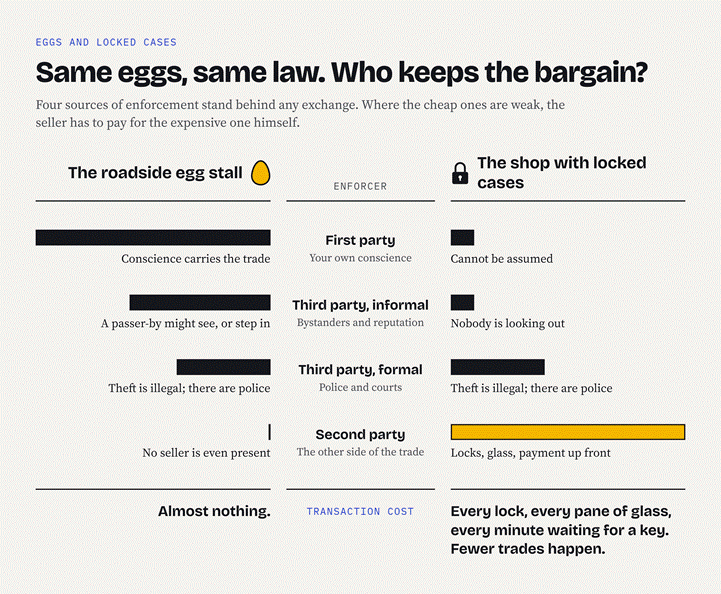
Now assume the two cases have equal formal enforcement. Police. Court system. All of it. In one, the buyer self-enforces against defection. Stealing would wound his conscience if he stole the eggs. He would feel bad. He would be “punished” by himself (we will later call this first-party enforcement). The exchange might also be enforced by the likelihood that a passerby would intervene, or would see, which might have reputational effects. (These are types of informal third-party enforcement, as against the formal third-party enforcement of the police.) Now suppose those three sources of enforcement (first party, informal third party, and formal third party) are weak. This leaves second-party enforcement. The shopkeeper must make expensive investments to secure the transaction himself. Political economists have a name for these unseen costs of making a trade, and they are a big part of the economy, actually.
Transaction costs are the costs of making an exchange work: finding out who you are dealing with, agreeing on terms, and making sure the terms are kept. Some key related terms:
• Institutions are the rules that bring those costs down. Douglass North divided them into formal ones (laws, courts, written contracts) and informal ones (norms, customs, manners). I will too, and I will call the informal ones norms: unwritten rules that people expect each other to follow.
• An incomplete contract is one whose terms cannot all be written down in advance, and whose performance an outsider cannot check. Most real contracts are like this to differing degrees. Securing a contract to buy an egg is different from securing one to buy uranium futures.
• Enforcement comes from three places besides the law: your own conscience (the first party), the person you are dealing with (the second party), and everyone else (third parties).
• Common knowledge means that everyone knows the rules and expectations, and everyone knows that everyone knows them.
• Preferences are the desires of participants in the exchange.
• Beliefs are the ideas participants have about how the world works (how their actions turn into outcomes), and expectations they have of others’ preferences and beliefs.
The egg stall runs almost entirely on first-party enforcement and that is the cheapest enforcement there is. Imagine the economic efficiency and development of a society where we never had to hedge against anyone cheating because everyone had a perfect conscience and ‘all men are angels’.
3. Amorous Exchange... Trading ‘sexy goods and services’
Now let’s think about hooking up at a party. Such a sexual encounter is about as incomplete as a contract gets.
(1) Nothing is written, and most of the terms are settled as things go along in continual negotiation.
(2) It happens in private.
(3) What separates a welcome act from a violation is a state of mind, which no outsider can reliably check. There isn’t any ‘standardization’ of sexual goods, like there is for farm-fresh eggs, which, outside of a nuclear fallout zone, are all pretty much the same.
(4) It cannot be undone.
(5) It can have an unexpected variety of social, medical, or lifelong consequences (positive and negative) that can arise over time, or in the case of a successful pregnancy, a lifetime.
(6) The two people are usually unequal in physical strength and in what they stand to lose. If one of them breaks the terms agreed (or believed to be agreed), the other has to enforce them alone, and is usually the smaller of the two.
The first three points summarize why the law is a weak backstop in amorous exchange. A court needs something it can verify. In the Cornell case, for example, the district attorney declined to charge in 2024 because, he says, the complainant’s sworn statement at the time described what happened as “voluntary, conscious, and consensual.” This was a ‘sexy goods exchange’.
The civil complaint now says she was incapacitated. One of the accused says he was too. If the complaint is right, this was not an exchange. It was a serious breach.
But what actually happened? Only spottily collected evidence meets our gaze, because only the participants to the contract were there.
The last three points are why the problem is enormously consequential and of high salience in nearly all societies, and why it’s pretty touchy for individuals too. These exchanges have tremendous personal and social impact, and can impact the entire destiny of an individual, family, community, or nation.
Again, this is why eros has been among the most thickly regulated aspects of social life, and the majority of that structure comes from “culture” and is a central concern of religions: the norms and values that people carry with them, what their partner can count on, and what the people around them will tolerate matters tremendously for individual and social life and well-being.
3a. A good spoiled by aggressive monitoring
There is one more feature of amorous exchange, and it belongs to the good rather than to the contract. The good degrades under observation for non-exhibitionists, and, more worryingly, for most people it degrades under self-observation. Clinicians have known since at least the 1970s that attending to one’s own sexual performance is itself a cause of sexual failure. Masters and Johnson called it “spectatoring”: the person watches and grades the act instead of being in it, and the watching produces the dysfunction. Later work narrowed the mechanism to attention. Anxiety on its own does not reliably reduce arousal, but attention turned inward, on how one is doing and how one is being read, does, for women as much as for men. The standard treatment since then has been to forbid evaluation during sex altogether.
In contracting terms this is kind of odd. Most contracts that I can think of are not harmed by careful negotiation. This one is. An exchange whose terms must be constantly negotiated while it happens puts both parties in exactly the position the clinic tries to get them out of. Every minute spent checking the terms is a minute spent as a spectator in the act, and the thing you wanted shrinks in proportion to your efforts to secure it.
So the six features above make the contract hard to secure, and this one makes securing it costly in a second way. The usual remedy for an incomplete contract, more monitoring, here consumes the good being exchanged. That is why default terms matter so much in this domain. Terms authoritatively settled in advance are the only kind that can be relied on without watching.
4. Elements of Contracting
To see how the dorm-room hook-up scenario of the mundane or far more bracing Cornell Seven variety stacks up, it is helpful to broadly compare one period of contracting with another, looking at how the structure of contract exchange is varied across time. Here are some elements of contracting that can vary between situations:
1. Default terms. What does everyone understand the exchange to be for, and which acts are in bounds? Default terms are the part of the contract nobody has to negotiate. Are preferences in society expected to be mostly “vanilla” or highly varied?
2. Screening. How much do the two people know about each other’s character before the stakes are high? How are beliefs formed?
3. Monitoring. Who else can see what is going on? Who gets to “participate” in the exchange, and at what point? What kind of “evidence” remains for others to observe later?
4. Stakes. What does a failed exchange cost, and who bears the cost?
5. Enforcers. Is conscience doing its work? Are third parties willing and licensed to step in if they are able to monitor?
6. Reputation. If someone behaves badly, how surely, how soon, and how severely do others find out?
7. Formal law. What can/will the state verify and punish?
Each of these raises or lowers the cost of negotiating and securing a reliable exchange. By reliable I mean that both people get roughly what they understood they were agreeing to.
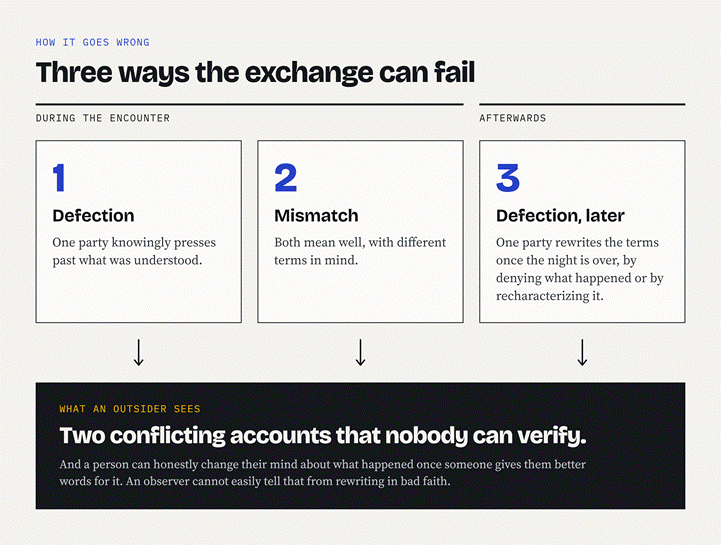
In essence, exchange reliability can fail in three ways. One party can defect during the encounter, knowingly pressing past what was understood. The two can mismatch during it, both meaning well with different terms in mind. Or one party can defect afterwards, rewriting the terms once the night is over, by denying what happened or by recharacterizing it.
All three can look the same from outside: two conflicting accounts that nobody can verify. There is a further complication. A person can honestly change their mind about what happened once someone gives them better words for it, and an observer cannot easily tell that from rewriting in bad faith.
5. Four stylized contexts of amorous contracting
The table sketches middle-class American courtship in four periods. It is stylized, and a historian could argue with every cell. But we are doing model illustrations for the sake of understanding the mechanism, and I think we will see expected behavior emerging in different scenarios that corresponds at least to many of our popular understandings of those periods.

Chaperoned courtship. Transaction costs for the standard contract were low for the two direct participants because almost nothing was left to the couple. They were borne largely by society. The terms were set in advance often by other people who were sober and not in love. Sex outside those terms was tied, explicitly and by design, to very large social costs: disgrace, a ruined match, a family’s lost standing. And third-party involvement could be near total. Family, neighbors, and church could see the courtship, knew the rules, and were expected to act. The price of the transaction costs being borne and shaped by society for the two main participants was a substantive constraint in their freedom to transact. The penalties for violating this fell much harder on women, and we can imagine that “optimal pairings” according to the tastes of those in the relationship were less significant than they would be if the couples could more freely search and explore.
Dating before the pill. The car took courtship out of the parlor, and further afield beyond dense local social networks. Monitoring fell but the stakes did not (pregnancy), so most of the default terms held. There were authoritative scripts of courtship, and they were gradual. Intimacy advanced by known steps, each tied to a level of commitment: dating, going steady, pinned, engaged. Every step was a signal, and skipping one told the other person something. The script pointed in one direction, toward marriage. After all, pregnancy was a constant possibility.
Enforcement stayed dense (though less so) and changed hands. Parents set curfews and met the boy at the door. Schools and colleges ran chaperoned dances, housemothers, and visiting hours. Peers kept score, and a reputation in a school or a small town was hard to outrun. Conscience still did much of the work, since both had been raised on the same rules. Once the car door closed, though, the second party was on her own, and more of the enforcing fell to the woman. When the contract failed, the community had a remedy: he married her, under intense pressure from informal third parties. The alternative was costly self-banishment.
Dating after the pill. This technological change was far more revolutionary than the automobile for amorous exchange, obviously. Once some women could have sex without risking pregnancy, no woman could easily hold out for commitment as the condition, because a man could find the exchange elsewhere without it. Thus, over time the commitment term dropped out of the default contract.
The single script split into several. Sex could now come early, as a way into a possible relationship: you slept together and then found out whether it would become something. Or it could be casual, with no sequel intended. The steps of intimacy kept their order but lost their tie to commitment, so the same act no longer told you which path you were on. People had to signal it. For a while a new norm held: casual sex was fine in its place, but letting someone believe it was more than that counted as defection. The enforcers thinned out in stages. Universities gave up parietal rules and stopped acting in place of parents, who were now far away. Peers still judged, but by the new norm: the offense was misleading someone, and the act itself was no longer anyone’s business. Conscience held longest, because the people making these choices had been formed under the older rules.
Now. The smartphone supplies scripts, but they are private ones, served to each user separately, so they cannot be common knowledge. There is no longer a shared order of steps. Sex can come before a first date, before a real conversation, before either person has decided whether they like the other. The default reading is a casual exchange of pleasure with nothing implied, and what follows is undefined. Asking where things are going is the awkward move. It matches strangers who share no friends. And the last substantive rule, that some acts are beneath a person, has been replaced by a rule against saying so. We have a word for the friend who steps in (”cock-blocking”) and a word for the friend who objects (”kink-shaming”). And it’s fair enough. Who are you exactly to intervene in a private exchange between two people who are doing something that doesn’t affect you? It’s the 21st century.
6. “Comparative Statics”
As with our discussion of ‘cold exchanges’, what follows is a stylized version of an exercise economists call comparative statics. We take the model, set its conditions as they stood in each period, and ask what behavior it leads us to expect in each. The aim is to hypothesize, in theory, how the four states should differ given the logic of our model. That is why stylized descriptions are enough for my purposes here. The exercise only needs each column to get the conditions roughly right, so that we can reason about what we should expect to follow from them if they were accurate. Follow five of the seven rows from left to right, and we would expect the cost and, importantly, the complexity of negotiating a reliable exchange to rise at each step. Default terms thin out until everything must be negotiated on the spot. Screening shortens. Monitoring declines. Enforcement narrows to the participants themselves. Reputation turns from a small, certain cost into a rare and enormous one, which deters badly and gives everyone a reason to fight over the record.
The other two rows, stakes and formal law, moved the other way. The pill lowered the stakes of one kind of failure. And the law improved: it is far better than it was at the cases it can verify, those involving force, strangers, or physical evidence. A fair reading is that the formal row got stronger while every informal row got weaker. By now, though, the loss of informal restraints may be overwhelming what our formal rules, and a basic public ethic of consent, can manage given the challenges inherent to amorous exchange.
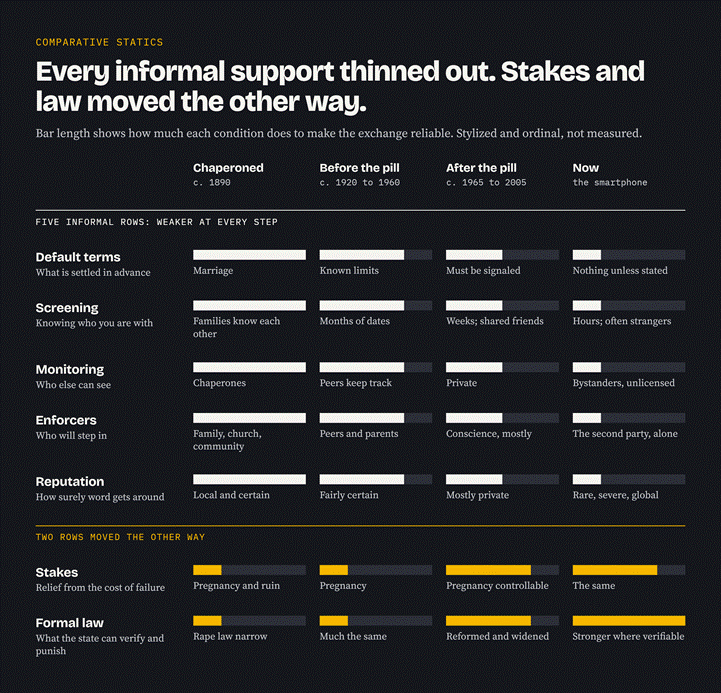
The bars are highly stylized for simple illustration. They illustrate the direction of change in each row and carry no quantitative information.
There is also a question about timing. Under the older contracts the terms were drafted in advance. Under consent alone they are drafted at one in the morning by two people who have been drinking. We moved the negotiation over time to the moment when people are least able to negotiate. And to the moment when negotiating does the most damage. Under the old contracting context the terms were settled before anyone was in the room, so that nobody in the room had to attend carefully to the unfolding of a potentially high-variance agreement.
Under consent alone, the only way to be safe is to watch warily and wearily as each action unfolds, and psychologists tell us that watching is the thing that spoils it. The young men in the interview studies who describe check-ins as a “checklist” that cost them relationships are reporting this mechanism from the field.
The model makes four predictions. I can illustrate each one here.
(1) More mismatch. A student life officer once described to me students who came to her saying: I think I might have been raped. I don’t know. He doesn’t know either. Neither had terms to compare the night against. The officer was absolutely befuddled about what to do, as were both parties to the possible misconduct.
(2) More defection during the encounter. Where nothing makes it costly, relative power decides: numbers, strength, sobriety, status. This is the hardest of the four to observe, because it falls in the category the law cannot verify. Survey measures of assault where incapacity is at issue are the place to look.
(3) More defection afterwards. When nothing can be verified, denying what happened and redescribing it later are equally cheap. Two things raise the temptation. First, the cost of an encounter can change after it is over. Once a night becomes gossip or a post, the price of having been a willing participant goes up, and so does the price of admitting what you did. Second, the forum matters. A tribunal that decides on a low standard of evidence, as many campus Title IX boards do, lowers the cost of a weak or bad-faith complaint, just as a criminal court’s high standard lowers the cost of a false denial. Since all three failures reach an outsider as two conflicting accounts, and people also change their minds honestly, nearly every case can become a dispute. The accused take on higher risks in low-standard courts, and the victim higher risks when relying on high-standard courts.
(4) Fewer and more exhausting exchanges. When a trade is costly to make safe, careful people stay home. Young adults are in fact having less sex than their parents did at the same age. Other things could explain that too (screens, living at home longer, less drinking), so it fits the model and proves nothing. But it obviously will be uncomfortable and exhausting to engage in such expensive and risky exchanges.
Now return to the question. How could they? On the reporting so far, a message advertising the woman went to a fraternity group chat with fifty-seven members, and I have seen no report that anyone objected. In texts reported by ABC News and TMZ, the complainant’s first response as the story spread on campus was that none of it had been illegal, that “everyone needs to grow up” because sex is changing, and that she was “really open minded.”
Those are the default terms that a consent-only standard supplies in a seemingly ever more liberated world: if everyone agreed, nothing was wrong, and everything is equally on the table.
Whatever happened upstairs, the record suggests that at the time it cost the men in that house very little. No shared rule marked it as out of bounds. Nobody who knew of it seems to have felt licensed to stop it. And conscience, where it was consulted, had been trained on the rule that anything agreed to is fine.
In a world where every act is legal with agreement, and agreement occurs privately, and in a social context where the liberty is jealously guarded, trying to ascertain if what you are seeing at a party is a crime or extreme sexual sport is costly to determine. Add alcohol and drugs, and it’s not surprising that so many report sexually transgressive experiences.
That last point is a transaction-cost story too. Norms are goods that someone has to realize. Teaching them, signaling them, and sanctioning the people who ignore them all take coordination. When coordination gets expensive, less chivalry is supplied.
7. What do I think that this teaches?
So the boring answer to “how could they?” about whatever happened at that frat house and countless other unreliable encounters may just be transaction costs. Over a century, the cost of making this exchange reliable moved off the community and onto two people in a dorm room or frat house.
The story here does not tell us what the terms of the amorous contract should be. It tells us that there will be terms, that leaving them unwritten has a cost, and that the cost falls on whoever is weakest in the room. But, there are clearly better and worse reliable amorous transactions.
But, as I will discuss in a second part to come, entering into this domain raises deeply thorny questions endogenous to the politics of liberation that have been so instrumental in moving every sexual practice under the sun from the shadows to perhaps your local city’s pride parade.
The picture sketched here corresponds to roughly the changes I have seen on campus from when I first entered college in 1998 through being a grad student TA, and professor. I see, and students report, fewer shared scripts (for a while there even what pronoun to use was a concern for one’s approach), more confusion, greater frustration and most ubiquitously expressed (at least to me), exhaustion.
It seems like it sure is less and less fun to seek romance on campus as the years roll by. A stressful liberation, where women fear being assaulted to the ruination of their happiness, and men fear doing harm, or being accused of it, to the ruination of their happiness. Women have more to fear: in one national survey they were more than twice as likely as men to report a sexual situation that scared them. But both are fears of a failure that nobody could verify, and both change how people behave.
But, exhaustion and fear are exactly what I would expect from an environment where contracting over something as valued as intimate connection is confusing, risky, and potentially dangerous, and you feel you must face it alone. It should be exhausting, and even avoided, as the dropping rates of sexual activity among the young generally might suggest.
Recent interview studies of young men and women report much the same: vigilance, fear of being harmed, fear of doing harm, fear of accusation, and little pleasure. [2] These are the reports one would predict from people negotiating a high-value, high-risk good under great uncertainty and opacity, without reliable enforcement of claims. In one study a participant describes amorous exchange as “trying to defuse a bomb”. For women, it’s like trying to avoid getting shot.
A viral response to how to deal with this problem illustrated by the Cornell story came from students themselves. Writing in the Harvard Crimson, Yona Sperling-Milner argued that consent is “a legal standard, not a comprehensive ethical guide,” and that we need an ethics of dignity upheld by the culture, by mentors, and by friends in a dorm room at 2 a.m. Christine Emba made a similar case in 2022. In the terms used here, that is a proposal to lower transaction costs by restoring default terms and third-party enforcement.
I agree, of course. But I think the issue is quite a bit thornier than they suspect. Norms of that kind are far easier to lose than to build, and a liberal society has particular trouble building this one, particularly after making it its mission to liberate eros as much as possible under the half-blind eye of consent... but that is a subject for another piece.
[1] A note on what I am claiming
So, to be clear, my point here is to explain why these things could happen, and why we should expect them more, rather than to praise or condemn any particular aspect of this outcome, or excuse any harm that arises from it.
If the allegations in the Cornell complaint are true, they describe a crime, and nothing I say is meant to refute that. However, I am asserting that the context of contracting surrounding cases like that of the Cornell Seven makes it extremely difficult for courts to affirm or refute the allegations, and thus “back up” contracts of amorous exchange. Indeed, this is part of why these things are happening and why people are fighting so much about the case.
[2] A note on the evidence
This is hardly a research paper. It’s a Substack post, after all. But after writing the section above I did a casual foray through the literature to see whether anything out there looked like the story I’m telling, and I was a bit surprised by how much did. So, with the usual caveat that interview studies rest on a few dozen volunteers and none of these sources tracks the same thing over time, and any real test of any claims here would require empirical modelling fit for purpose, here are some things I deeply unsystematically found:
• Jossy Forrest, Jessie V. Ford, and Jonathan Herring, “’It’s Like You’re Trying to Defuse a Bomb’: Fear, Responsibility, and Shame in Young Men’s Sexual Lives,” Journal of Sex & Marital Therapy (2026). Interviews with 31 heterosexual men aged 18 to 32. They described vigilance during sex, worry about harming a partner, and shame, and they rarely described enjoyment.
• Andrea Waling, Sexuality Research and Social Policy (2025). Interviews with 30 Australian men aged 18 to 35. They could read a partner’s cues but doubted whether her interest was freely given. Repeated verbal check-ins felt like a checklist, and some partners objected to them.
• Cary and colleagues, Journal of Interpersonal Violence (2022). Focus groups with 34 American students aged 18 to 26. Women spoke of fearing assault. Men spoke of fearing an accusation, including after sex they believed was consensual.
• Debby Herbenick, Elizabeth Bartelt, Tsung-chieh Fu, Bryant Paul, Ronna Gradus, Jill Bauer, and Rashida Jones, “Feeling Scared During Sex: Findings From a U.S. Probability Sample of Women and Men Ages 14 to 60,” Journal of Sex & Marital Therapy 45, no. 5 (2019): 424–439. A national probability sample of Americans aged 14 to 60. Among adults, 23.9 percent of women and 10.3 percent of men reported a sexual situation that scared them. The situations they described included being held down, choking, threats, and more than one partner.
• Debby Herbenick and colleagues, national probability survey of American adults aged 18 to 94 (2021), as reported in Herbenick et al., Sexuality Research and Social Policy (2025). At their most recent sexual event, 35 percent of women aged 18 to 24 had been choked, against 11 percent of women aged 25 to 39 and under 3 percent of women aged 40 and over.
• Debby Herbenick and colleagues, “Frequency, Method, Intensity, and Health Sequelae of Sexual Choking Among U.S. Undergraduate and Graduate Students,” Archives of Sexual Behavior 51 (2022): 3121–3139. A campus-representative survey of 4,254 students. 57.6 percent of undergraduate women had been choked during sex, and the mean age at first experience was 19. In the companion paper above, 92.7 percent called their most recent experience consensual, yet half had agreed no safe word and 38 percent had signalled consent by body language alone.
• Institute for Addressing Strangulation, Strangulation During Sex in the UK (2025). A weighted survey of 4,175 Britons aged 16 to 34. Among the sexually experienced aged 24 to 26, 72 percent had been strangled during sex. In 26 percent of cases the last instance had not been discussed beforehand, and of those, 24 percent felt scared.
• Daniel A. Cox and Kelsey Eyre Hammond, Romantic Recession, Survey Center on American Life (2025), from surveys of 5,837 and 5,244 American adults. 35 percent of single women, against 16 percent of single men, think most or all men would take sexual advantage of a woman given the chance. The share of unmarried women who call dating apps safe fell from 58 percent to 35 percent in five years. 34 percent of adults report a consensual sexual experience they later regretted, and the share rises with the number of partners.
• Gallup, as reported by Daniel Cox. The share of American women under 50 who often or sometimes worry about sexual assault rose from 39 percent in 2017 to 55 percent in 2023.
A few things jumped out at me.
The fear runs on both sides, and it runs through the whole encounter. Men talk about misreading, doing harm, and being accused afterwards. Women talk about assault, and a third of single women now assume most men would take advantage of them given the chance. Different fears, same structure: a counterparty whose intentions you cannot verify before, during, or after.
The default terms have moved within a single generation. Choking is now reported by a majority of undergraduate women, and by a third of women aged 18 to 24, against almost none of their mothers’ cohort. It arrived with no shared script. Half of those choked had agreed no safe word, a third had signaled consent with body language alone, and in the British survey a quarter had not discussed it at all. A new term entered the contract through private negotiation, or none, which is where the table says we are.
Regret is common, and it rises with the number of exchanges. Regret is the first step in a redescription, honest or otherwise, and the model says redescription gets cheaper as exchanges multiply and verification stays impossible.
None of this proves the fears are new, or that the changes in the table caused them. The choking numbers come closest, since the age gradient is steep and the practice spread in two decades. But it all sits where the model says it should, and it suggests that recent attempts to secure these transactions (such as #metoo) may have side effects nobody intended if one doesn’t take into account the entire context of contract negotiation and enforcement.
I will add that these discussions mirror those I have seen emerging among and with students over the last 20 years I have been in regular contact with college undergrads as an instructor. As scripts and categories blurred and options radically expanded I have seen an increase in cynicism, anxiety, and expressed categorical dissatisfaction with regard to amorous exchange and a rising mistrust and in some cases contempt between the sexes.
It is the sense of something bleak here that struck me when the first group of students did a 10-minute presentation on this about 8 years ago. The kids may be alright, but they don’t seem very happy with this part of their lives, and if that is the case in college, that seems very foreboding indeed for the broader society.
Sources and further reading
The Cornell case and the Crimson
• Yona T. Sperling-Milner, “The Cornell Case Shows Gen Z Is Moving Away From an Ethics of Consent” Harvard Crimson, October 7, 2026. https://www.thecrimson.com/article/2026/10/7/sperling-milner-harvard-sexual-ethics-of-consent/
• ABC News / Good Morning America, reporting on the complainant’s texts. https://www.goodmorningamerica.com/news/story/cornells-jane-doe-felt-sex-doll-after-alleged-136944644
• TMZ, October 9, 2026, reporting on the complainant’s texts. https://www.tmz.com/2026/10/09/cornell-jane-doe-texts-with-accused-fraternity-brother-about-rumors/
• Tompkins County District Attorney, statement regarding Jane Doe v. Cornell University et al., September 28, 2026. The source of the “voluntary, conscious, and consensual” quotation and of the 2024 decision not to charge.
o NPR, “Cornell agrees to an independent probe into its handling of a fraternity rape case,” September 28, 2026.
• Christine Emba, Rethinking Sex: A Provocation (2022).
Transaction costs, contracts, and institutions
• Michael Munger, The Answer Is Transaction Costs (podcast) and here is a link to his podcast episode on dating and marriage.
• Ronald Coase, “The Nature of the Firm” (1937) and “The Problem of Social Cost” (1960).
• Douglass North, Institutions, Institutional Change and Economic Performance (1990).
• Elinor Ostrom, Governing the Commons (1990).
• Oliver Hart, Firms, Contracts, and Financial Structure (1995), on incomplete contracts.
• Robert Ellickson, Order without Law (1991), on first-, second-, and third-party enforcement.
The four periods
• Beth Bailey, From Front Porch to Back Seat: Courtship in Twentieth-Century America (1988).
• George Akerlof, Janet Yellen, and Michael Katz, “An Analysis of Out-of-Wedlock Childbearing in the United States,” Quarterly Journal of Economics (1996), on the pill and bargaining.
• Kathleen Bogle, Hooking Up (2008), and Lisa Wade, American Hookup (2017).
Spectatoring
• William Masters and Virginia Johnson, Human Sexual Inadequacy (1970).
• David Barlow, “Causes of Sexual Dysfunction: The Role of Anxiety and Cognitive Interference,” Journal of Consulting and Clinical Psychology 54, no. 2 (1986): 140–148.
The legal proceedings in the Cornell case are ongoing. The allegations described are drawn from the civil complaint filed September 16, 2026, from the Tompkins County District Attorney’s statement of September 28, 2026, and from published reporting on the 2024 investigation. The district attorney declined to bring charges in 2024. On September 28, 2026 he reopened the investigation and said he would present the case to a grand jury. As of this writing no one has been criminally charged, and the accused deny wrongdoing. Cornell has confirmed that its own disciplinary process resulted in expulsions and suspensions. Nothing in this essay should be read as a determination of the guilt or innocence of any individual.
Great post with lots to chew on. I think that the Cornell7 "lead" is a maybe a bit misleading compared to what you're trying to get at (thus your caveats), so I hope readers have the patience to read thru your thoughts. My one substantial comment: It would be useful to consider time, as in repeated interactions (the term in game theory as well as dating :), and how those work to help both sides align and understand. The "one night stand" has always been around, as has rape, and the two have often been confused -- rightly -- due to their one-off nature. That's why people date (or court) more than a few times, to get to know each other. I think the C7 lead kinda misses that element in today's romance, since most of the 20 year olds these days DO take time to try to know each other, which is why the dating apps are fading in popularity, even when "the youth" are addicted to their phones for other things.
"Only connect" is still the goal.